


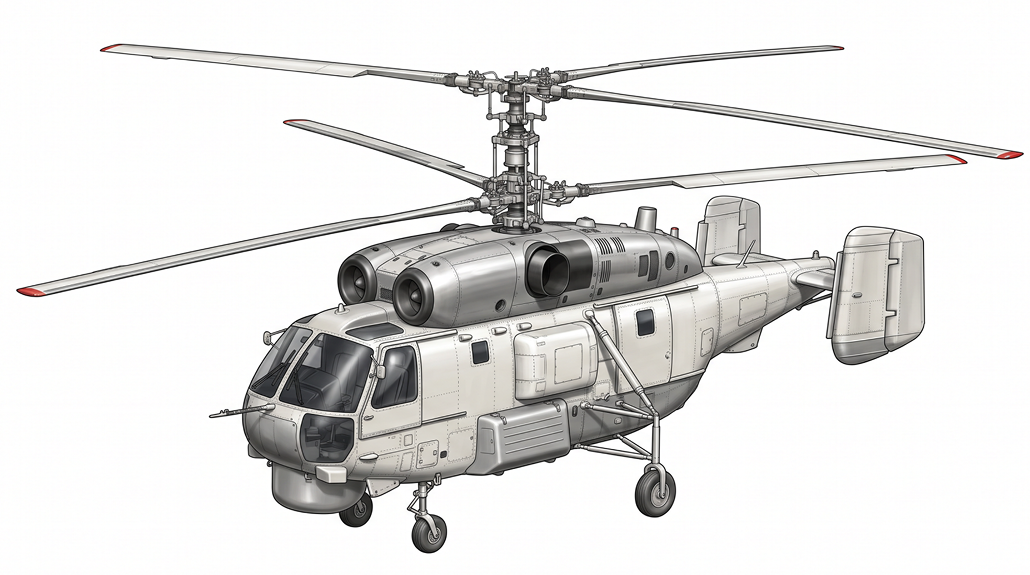
Ka-32: the Russian "flying crane" for demanding tasks
The Ka-32 is one of the most recognisable Russian rotorcraft on the international market. This helicopter is of interest above all as an example of a successful combination of high payload capacity, exceptional manoeuvrability and broad specialisation: it works confidently where other helicopters find it too cramped or too demanding.
Origins and concept
The history of the Ka-32 begins at the N. I. Kamov Design Bureau. Its "signature style" — the coaxial main rotor configuration (two rotors one above the other, turning in opposite directions) — became the aircraft's principal technical advantage. Unlike the conventional configuration with a tail rotor, the coaxial configuration makes the helicopter more compact, more stable and more precise to control, and also eliminates the vulnerable tail rotor and its transmission.
The prototype Ka-32 made its first flight in 1973, and series production began in the 1980s at the Kumertau Aviation Production Enterprise (KumAPP). The aircraft was originally conceived for ice reconnaissance in the Arctic and for work with icebreakers: the Ka-32 escorted vessels through the polar night, assessed ice thickness and helped to plot routes. It soon became clear, however, that the potential of the helicopter was far broader.
Technical features and flight performance
The coaxial rotor configuration is not merely an engineering "flourish" but the basis of the Ka-32's operational qualities. Thanks to it, the helicopter:
- holds position in the hover excellently even in strong winds;
- flies confidently in mountains, over the sea and in dense urban areas;
- can land on confined sites — for example, on ship decks or drilling platforms.
Key specifications of the current baseline Ka-32A11BC version:
- maximum take-off weight — up to 12 700 kg;
- payload capacity on the external sling — up to 5 000 kg;
- cruising speed — about 245 km/h;
- service ceiling — 5 000 m;
- range — up to 650 km (with auxiliary tanks — up to 870 km).
These figures make the Ka-32 one of the leaders in its class in terms of the ratio of payload capacity to range.
Specialisation and operational tasks
The Ka-32 is often called a "flying crane" — and for good reason. Its main applications:
Firefighting
The helicopter is fitted with water discharge devices (VSU) with a capacity of up to 5 000 litres. Water is scooped up in a matter of seconds and released precisely onto the seat of the fire. The latest variants (for example, the Ka-32A11M) use the SP-32 system with electric heating, which makes it possible to fight fires even at sub-zero temperatures.
Construction, installation and work at height
Thanks to its high hover precision and payload capacity, the Ka-32 is used to install power transmission line pylons, crane sections, air conditioning units on skyscrapers and other heavy structures.
Logging
In Canada and a number of other countries the helicopter was used for timber extraction — carrying bundles of logs on an external sling.
Search and rescue operations
The helicopter is able to operate at night and in difficult weather conditions and to evacuate people from vessels, mountain areas and hard-to-reach locations.
Oil and gas industry support
The Ka-32 delivers cargo to offshore platforms, assists in unloading vessels and supports operations in remote areas.
Variants and international certification
One of the reasons for the success of the Ka-32 abroad is its adaptation to the requirements of different countries. The best-known export version is the Ka-32A11BC. The letters "BC" refer to the Canadian province of British Columbia: the modification was developed specifically for it and later became the standard for many foreign customers.
The Ka-32A11BC has been certified in a number of countries, including Canada, Switzerland, South Korea, China and others. This has allowed the helicopter to compete confidently on the international market and to establish itself in the fleets of rescue and firefighting services.
A newer version — the Ka-32A11M — received VK-2500PS-02 engines, modern avionics and improved firefighting equipment. At the 2023 Dubai Airshow this variant attracted considerable interest from potential customers.
Operating geography and examples of use
Today the Ka-32 is operated in more than 20 countries, including:
Canada
The helicopters were used for logging and rescue operations.
Switzerland and the Alpine countries
These helicopters are used for installation work in the mountains — for example, erecting ski lifts and cable car pylons.
Spain and other countries of Southern Europe
The Ka-32 is widely used in fighting forest fires.
Asia
The helicopters operate in South Korea, China, Indonesia and other countries, performing a wide range of tasks — from firefighting to infrastructure servicing.
One striking example is work in the mountain regions of Europe, where the helicopter is required to deliver literally "millimetre" precision. The coaxial rotor configuration of the Ka-32 offers a tangible advantage here: the aircraft "yaws" less in the hover and responds better to pilot inputs than helicopters of conventional configuration.
Why the Ka-32 is valued abroad
For foreign operators the Ka-32 is attractive for several reasons:
High payload
The ability to lift up to 5 tonnes on an external sling opens up niche but in-demand tasks.
Compact size and manoeuvrability
The coaxial rotor configuration allows operation in confined conditions — over cities, on ship decks and in mountains.
All-weather capability and reliability
The helicopter is designed for operation across a wide range of temperatures and weather conditions, including maritime environments and mountainous areas.
Configuration flexibility
The helicopter can be quickly reconfigured for different tasks — from firefighting to the installation of heavy structures.
Outlook
The modernisation potential of the Ka-32 is still far from exhausted. New engines, modern avionics and specialised equipment extend the helicopter's capabilities and keep it competitive on the global market. At the same time its key advantages — the coaxial rotor configuration, high payload capacity and hover precision — remain unchanged and continue to attract customers in many countries.