


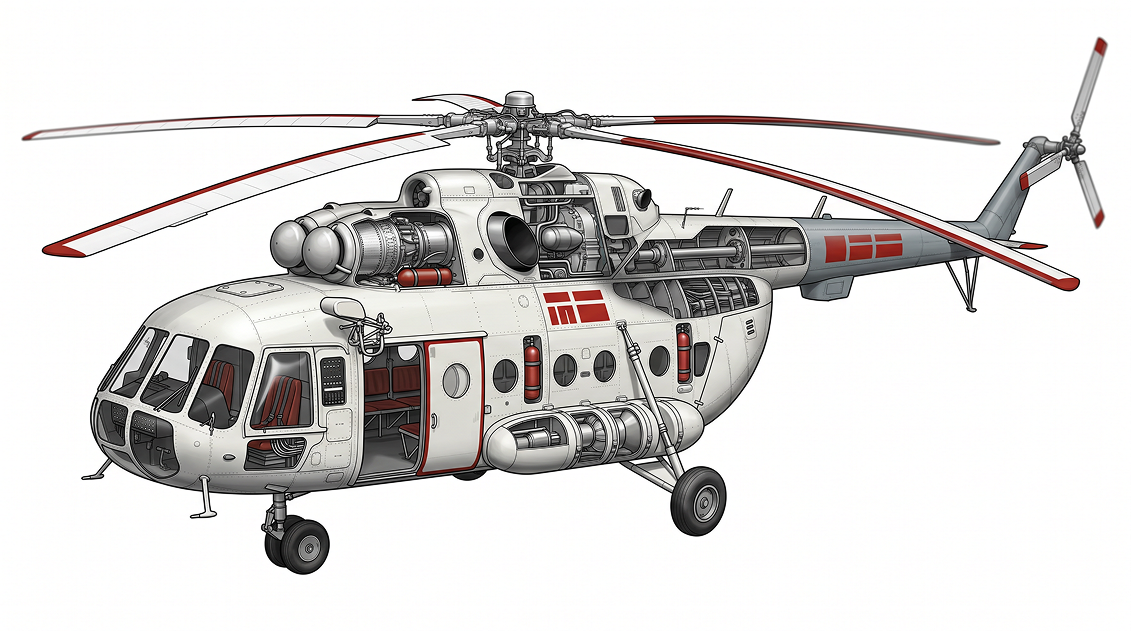
Mi-8/17: the technical evolution of a legend
The Mi-8, or Mi-17, is not simply the "workhorse" of aviation but one of the most technologically flexible helicopter platforms in the world. In a modern technical publication this story is of interest not for its nostalgia but for its engineering logic: how a basic design created in the 1960s still withstands competition through successive modernisations, standardisation and a well-considered operational architecture. Below is a review of its evolution, the key technical changes, the unique engineering solutions and the range of tasks it performs, with a focus on present-day operating and production realities.
From prototype to industry standard: the design logic
Development of the Mi-8 and its export counterpart, the Mi-17, began as the task of moving from a piston layout (the Mi-4) to a gas-turbine one, while simultaneously increasing payload capacity, service life and operational flexibility. The first V-8 prototypes (with a single AI-24V engine) revealed the fundamental vulnerability of a single-engine layout: insufficient fault tolerance and a limited thrust margin.
The V-8A prototype (1962) implemented the key design concept: a twin-engine layout based on the TV2-117 and a five-blade main rotor. This provided the necessary balance between thrust, manoeuvrability and survivability. Further evolution followed the path of scaling and standardisation: series production at the Kazan Helicopter Plant (from 1965) and the subsequent roll-out at the Ulan-Ude Aviation Plant (from 1970) made it possible to create a single manufacturing and repair ecosystem.
From an engineering standpoint, it was precisely the standardisation of assemblies and units that became the foundation of the platform's longevity: it ensured predictable spare parts logistics, standardised overhaul procedures and the ability to modernise large batches of aircraft in parallel.
Modernisations: engineering solutions for new tasks
The modernisation path of the Mi-8 and Mi-17 helicopters can be seen as the successive solving of specific technical limitations: thrust at altitude, vibration, navigation accuracy, survivability and adaptation to extreme conditions.
Powerplant and transmission
The switch from the TV2-117 to the TV3-117 (the Mi-8MT modification, 1975) delivered a substantial power increase and improved hot-and-high performance. The subsequent introduction of the VK-2500 engine family (including the VK-2500PS-03) made it possible to operate the aircraft confidently in hot climates and in mountains, where a loss of thrust is critical for payload.
The transmission was upgraded in parallel: fitting the VR-14 gearbox in place of the VR-8A, moving the tail rotor to the left side (on the Mi-8MT) and introducing an X-shaped tail rotor increased the directional control margin and reduced vibration. Composite main rotor blades further improved the acoustic profile and increased time between overhauls.
Avionics and navigation
The transition from analogue instruments to a "glass cockpit" with display indication and a digital autopilot (for example, the PKV-8) reduced crew workload and improved the accuracy of flight at extremely low altitudes and in difficult weather conditions. The integration of satellite navigation and IFF systems made it possible to embed the helicopter into modern air traffic control loops and automated troop command and control systems.
Weapon and protection suites
Variants such as the Mi-8AMTSh ("Terminator") show how a civil platform is adapted to stringent combat survivability requirements: cockpit armour, flare dispensers, exhaust gas diffusers and electronic warfare suites. The integration of external weapons (unguided rocket pods, machine gun and cannon pods) extends strike capability without losing transport functionality.
Climatic and special adaptations
The Arctic version, the Mi-8AMTSh-VA, includes enhanced thermal insulation, heating systems for critical units, skis instead of wheels and adapted starting systems for temperatures down to -60 °C. The offshore version, the Mi-171A3, is optimised for operation over the sea: corrosion-resistant materials, sealed compartments and dedicated avionics improve reliability in the aggressive marine environment.
Unique technical features: why the platform remains in demand
From an engineering standpoint, the uniqueness of the Mi-8/17 is made up of several factors:
High repairability and modularity
The design is intended for field repair and replacement of units where technical facilities are limited. Standardised assemblies and proven overhaul procedures make it possible to restore the aircraft to serviceability quickly.
Configuration flexibility
A single platform can accommodate transport and passenger, medical evacuation, search and rescue, attack and reconnaissance versions. This reduces the range of types required in a fleet and simplifies spare parts logistics.
Survivability and fault tolerance
The twin-engine layout, redundancy of the control systems and design solutions protecting the fuel and hydraulic lines increase the probability of the aircraft returning to base even after serious damage.
Operation in harsh conditions
The helicopter remains serviceable across a wide range of temperatures, at high altitude and in limited visibility, which makes it suitable for use in a variety of climatic zones.
Range of tasks: from logistics to special missions
The technical versatility of the Mi-8/17 allows it to be used in a wide variety of scenarios:
Transport and cargo operations
Carriage of passengers (up to 24-28 people) and cargo (up to 4 tonnes inside the cabin), as well as on an external sling — in demand in construction, geological exploration and the delivery of equipment to remote sites.
Medical evacuation missions
Medical modules with stretchers, ventilators and defibrillators make it possible to provide emergency care and evacuate casualties from hard-to-reach areas.
Search and rescue operations
Thermal imagers, searchlights, hoists and systems for locating persons in distress increase operational effectiveness at night and in difficult weather conditions.
Firefighting and emergency response
Dropping water or fire-extinguishing agents and delivering firefighters and equipment to seats of fire — important tasks for regions with a high fire hazard.
Agriculture and the environment
Fertiliser spraying, crop treatment, aerial photography and forest fire monitoring — examples of effective use of the helicopter platform in civil sectors.
Military and security tasks
Troop insertion, fire support, casualty evacuation, reconnaissance and electronic jamming — these are the areas where the Mi-8/17 remains one of the most in-demand helicopters in the world.
Special missions
From delivering mail and food to remote settlements to recovering cosmonauts after landing — the range of applications is almost unlimited.
Geography and operating ecosystem
The Mi-8 and its variants are operated in more than 80 countries. They are especially valuable in regions with poor ground infrastructure: Siberia, the Russian Far East, Africa, South-East Asia and Latin America. For operators this means steady demand and the opportunity to build long-term contracts with government and private customers.
On the international market, Mi-8 and Mi-17 helicopters are in demand wherever ease of operation, spare parts availability and the ability to work in harsh climatic conditions matter. An extensive network of repair enterprises and component suppliers makes logistics predictable and the cost of ownership — controllable.