


Arranging
overhaul of
helicopters
Order service
For helicopter operators, arranging an overhaul is a critically important task that directly affects flight safety, fleet economics and compliance with international and national airworthiness requirements. A helicopter that has exhausted its time between overhauls cannot be operated, and equipment downtime translates into direct losses.
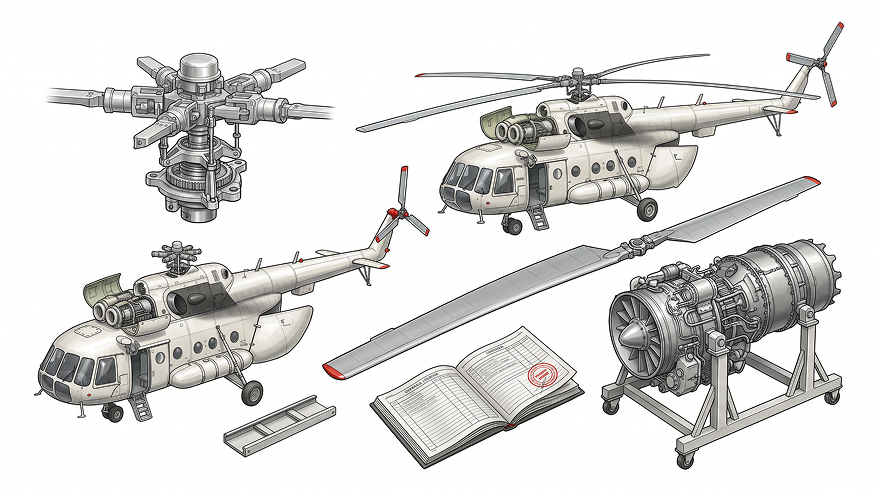
Armada-Group acts as the single operator for arranging overhaul of Mi-family helicopters for operators from friendly countries.
Company competencies
- Full repair cycle. Overhaul of the airframe, powerplant, transmission, main rotor system, hydraulic and fuel systems, electrical equipment and avionics in accordance with the current operating and repair documentation.
- Modernisation and retrofitting. The option to integrate modern communication and navigation equipment, update instrument equipment and improve the service life figures of units.
- Arranging temporary import and export. The company fully covers the customs procedures: it prepares the document package for the temporary export of the helicopter from the country of operation to the Russian Federation, arranges temporary import to the repair plant's premises, and handles re-export once the work is completed. This includes liaison with the customs authorities and the preparation of declarations, certificates of conformity and other permit documents.
- Technical audit. Before repair begins, the company carries out an on-site technical audit at the helicopter's base: it assesses the actual technical condition, records the defects found, compiles a defect report, and determines the scope of work and the preliminary price. Following the audit, the customer receives a transparent repair plan and a schedule of execution.
- Logistics and transportation. Arranging ground and air movement of the helicopter (including in partially disassembled condition), selecting transport, obtaining overflight permits and providing ground support.
- Certification and documentation support. Entries are made in the logbooks, work completion certificates are issued, and a set of documents is prepared to confirm airworthiness and service life extension.
Outcome for the operator
- Guaranteed restoration of the helicopter's airworthiness, with confirmation of its service life and calendar life.
- Transparency and predictability. A fixed scope of work, schedule and price, approved at the technical audit stage.
- Minimised downtime. A precise schedule synchronised with logistics and the production capacity of the plants.
- Complete removal of the administrative burden. The company takes on all customs, certification and reporting procedures.
- Documentation recognised in the country of operation. A set of documents sufficient to amend the airworthiness certificate and continue operation.
Helicopter overhaul process sequence (from on-site disassembly to handover)
The overhaul process is strictly regulated and is carried out in stages:
- Preparation and removal work at the place of operation. At the home base aerodrome the systems are preserved, fuel and operating fluids are drained, and the removable units that it is expedient to take off before transport are dismantled (main and tail rotor blades, individual panels, cabin equipment). The helicopter is then secured for transport.
- Transport to the repair plant. Depending on the distance and the condition of the aircraft, the method of delivery is selected: a ferry flight (where the remaining service life allows and the systems are serviceable) or partially disassembled by road or on a railway flatcar.
- Acceptance and incoming inspection. At the plant the helicopter undergoes acceptance for completeness and external condition. Washing, removal of preservation compounds and an initial inspection for hidden damage are performed.
- Complete disassembly and defect survey. The helicopter is stripped down to units and assemblies: the fuselage, landing gear, tail boom, transmission, engines and main gearbox are removed.
- Every assembly undergoes non-destructive testing (visual and dimensional, dye penetrant, magnetic particle and eddy current methods) to detect cracks, corrosion and wear. A defect report and a list of the parts to be replaced are then drawn up.
- Repair and restoration of units. Airframe work includes straightening of structural members, replacement of damaged panels and restoration of the paint finish. Assemblies (gearbox, engines, pumps, hydraulic actuators) are overhauled in dedicated shops, with life-limited parts replaced and bench testing performed.
- Helicopter assembly. Units are refitted in place and the systems are installed: fuel, hydraulic, pneumatic, electrical power and flight controls. Control rods are adjusted, free play is checked and joints are checked for tightness.
- Ground tests and checks. Engine and transmission operation is verified across all modes, along with the functioning of the onboard systems, communications and navigation. Static tests are performed (for example, checks of landing gear and brake operation).
- Test flying and acceptance testing. The helicopter performs a series of check flights: hovering, turns, climb and en-route flight. Stability, controllability and the in-flight operation of the units are assessed.
- Final acceptance and documentation. The acceptance board confirms that the helicopter complies with the requirements of the technical documentation. Entries on the repair carried out and on the service life and calendar life are made in the logbooks. A set of documents is compiled for handover to the operator.
- Preparation for dispatch. The helicopter is preserved for transport, partially disassembled if required, packed and prepared for return to the country of operation. The company handles the temporary export and re-export procedures.
This approach allows the operator to receive a fully restored, tested and fully documented aircraft, ready for further operation without additional time and resources spent on arranging the repair.
[ Contact ]