


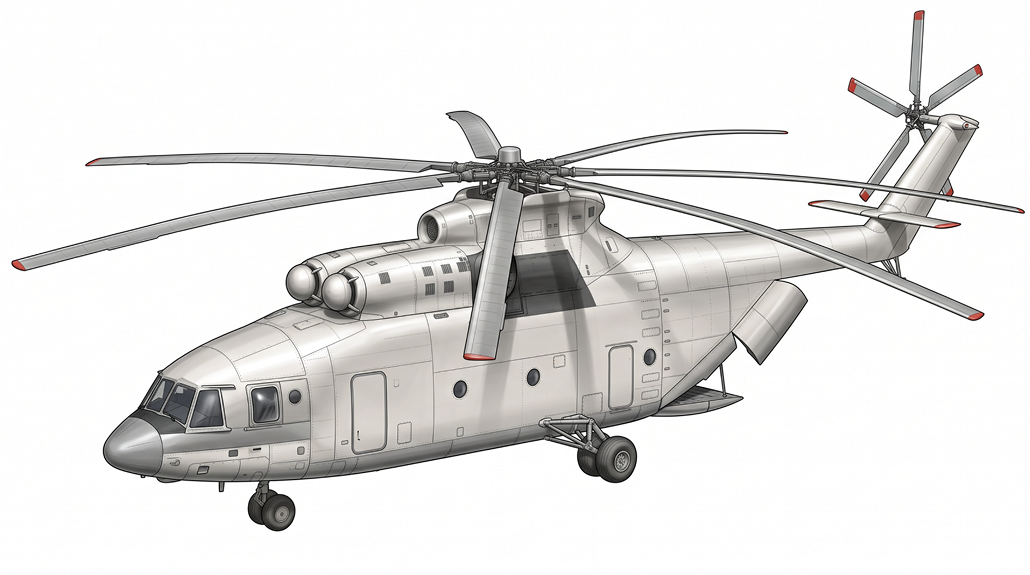
Mi-26: the giant of the skies
The Mi-26 helicopter is rightly considered the king of heavy rotary-wing aviation. It is not just a machine — it is an engineering phenomenon able to lift loads that are beyond most helicopters. Its silhouette is recognisable throughout the world: a massive fuselage, an enormous main rotor, impressive payload capacity.
The birth of a record-holder
The history of the Mi-26 began at the M. L. Mil Design Bureau in the 1970s. The designers faced an ambitious task: to create a helicopter able to carry oversized loads weighing up to 20 tonnes — from military vehicles to infrastructure components. The first flight took place in 1977, and series production started in 1980 at the Rostvertol plant in Rostov-on-Don.
From the very outset the Mi-26 stood out against other aircraft:
- payload capacity — up to 20 t inside the cargo cabin or on the external sling;
- main rotor diameter — 32 metres (the largest in the world among production helicopters);
- cargo cabin volume — 110 cu. m, which allows vehicles, containers and construction machinery to be carried.
These characteristics have made the Mi-26 not only a military aircraft but also a versatile transport aircraft for civil tasks.
From a military aircraft to a multi-purpose transport
The Mi-26 was originally developed primarily for army needs: recovery of damaged equipment, airlift of troops, transport of heavy weapons. However, in the very first years of operation it became clear that the potential of the aircraft was far broader. The helicopter began to be used extensively in the civil economy: in the construction of power transmission lines, in the oil and gas industry and in disaster relief.
It was precisely to broaden civil applications that the Mi-26T variant was created ("T" — transport). It retained all the advantages of the base version but received improvements aimed at commercial and industrial use.
What has changed in the Mi-26T
Modernisation to the Mi-26T version covered several key areas:
Adaptation to civil standards
The helicopter was fitted with equipment meeting civil aviation requirements, including navigation and communication systems suitable for flights under commercial air transport rules.
Cargo system optimisation
The cargo attachment fittings, the external sling system and the loading/unloading mechanisms have been refined. This has made handling various types of cargo faster and safer — from containers to long-length structures.
Improved crew working conditions
The cockpit received more modern instruments and improved ergonomics, which is especially important on long flights and demanding missions.
Improved operational reliability
Improvements were introduced to the service life of units and to the simplification of maintenance — a critically important factor for commercial operators.
As a result, the Mi-26T became the optimal choice for companies that need heavy rotary-wing aircraft to carry out real industrial and commercial tasks.
Where and how the Mi-26T is used
Today the Mi-26T can be found in the most varied corners of the planet. It is used for:
- Construction and power engineering. The helicopter delivers and installs sections of power transmission line pylons, bridge elements and modular buildings in hard-to-reach areas.
- Oil and gas industry. Transport of drilling equipment, erection of derricks, delivery of cargo to offshore platforms.
- In emergency response. Evacuation of people from disaster areas, delivery of humanitarian aid, firefighting with water discharge devices.
- Military logistics. Transport of vehicles, cargo and personnel in conditions where ground transport is impossible.
The Mi-26T is operated in Russia, the CIS countries, the Middle East, Africa and South-East Asia. The aircraft has proven itself in the harshest climatic conditions — from Arctic frosts to tropical heat.
Further evolution: the Mi-26T2 and present-day improvements
Development of the line did not stop with the T version. The Mi-26T2 variant appeared, with a "glass cockpit", digital flight and navigation suites and the ability to operate with a minimum crew. These changes improved piloting accuracy, simplified route planning and expanded operating capability in difficult weather conditions.
Nevertheless, it is the Mi-26T that remains the golden mean: for many operators it combines a proven design, high reliability and adaptability to a wide range of tasks.