


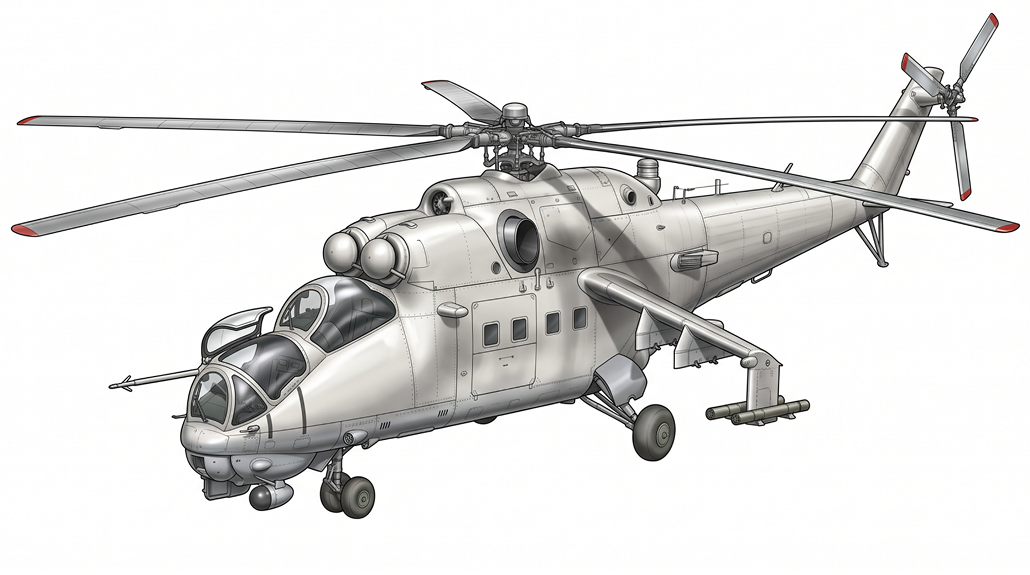
The "Crocodile" and its evolution: from the Mi-24 to the Mi-35 — power, reliability, a combat legend
The Mi-24 helicopter, known throughout the world by the nickname "Crocodile", is not merely a rotary-wing machine but a symbol of attack aviation, whose combat history spans decades of intensive operations in the harshest conditions. The platform proved its value in practice and then gained a new lease of life in the form of the modernised Mi-35.
The birth of a legend: the essence and power of the Mi-24
The Mi-24 was originally designed as a "flying infantry fighting vehicle": it had to deliver strikes and also carry troops. This duality became both its strength and a challenge for the designers. The result was a unique hybrid — an attack helicopter with a troop compartment, capable of performing a wide range of tasks from fire support to evacuation.
A powerplant of two TV3-117 turboshaft engines gives the aircraft a high power-to-weight ratio, while the large-diameter main rotor provides excellent lift even at high altitude and in hot climates. The armament of the Mi-24 can vary depending on the mission: from unguided rockets and cannon to anti-tank guided missiles. This flexibility allowed it to become a universal tool on the battlefield.
Combat record and proving in real-world conditions
The service history of the Mi-24 is a history of continuous testing to the limit. The aircraft has been through numerous conflicts, where its main strengths proved to be survivability and the ability to continue the mission even after serious damage. Cockpit armour, self-sealing fuel tanks and redundancy of key systems allowed the crew to return home even after taking enemy fire.
The "Crocodile" proved itself as an asset able to operate in difficult weather, by day and by night, in mountains and in deserts. Its ability to work from unprepared sites and to be redeployed quickly between sectors of the front made it indispensable for tactical manoeuvres.
Mi-24 variants: development of the platform
Many modifications have been built on the Mi-24 platform, each addressing specific tasks:
- Mi-24A — the first production version, which laid the foundation for the concept of an attack helicopter with a troop compartment.
- Mi-24D — a version with an improved cockpit layout (tandem crew seating), which improved survivability and field of view.
- Mi-24V — one of the most widely produced variants, fitted with armament that was modern at the time, including the "Shturm-V" ATGM.
- Mi-24P — a variant with a fixed cannon installation (twin-barrel GSh-30K cannon), aimed at maximum firepower.
- Mi-24K — a reconnaissance and artillery-spotting version intended for guidance and target designation.
- Mi-24R — a radiological and chemical reconnaissance helicopter equipped with special equipment for detecting hazardous substances.
- Mi-24VP — a later variant with improved armament and fire control systems.
Each of these versions expanded the range of tasks the "Crocodile" could perform and confirmed the versatility of the base platform.
From the Mi-24 to the Mi-35: evolution without losing the essence
Modernisation to Mi-35 standard was not an attempt to "freshen up" an old aircraft — it is a thorough redesign of the platform to meet modern requirements for combat effectiveness, survivability and versatility. At the same time the designers retained everything that was best in the Mi-24: strength, reliability and the ability to operate in harsh conditions. The key areas of modernisation:
Modern avionics and fire control systems
The Mi-35 is fitted with new targeting and navigation suites, thermal imagers and night vision systems. This allows it to operate effectively at night and in conditions of limited visibility, which is critical in modern conflicts.
Improved survivability
Armour protection has been strengthened and more advanced threat warning and jamming systems have been introduced. The helicopter has become even more resistant to damaging factors.
Design optimisation
Some variants have a reduced troop compartment — this made it possible to cut weight and improve flight performance while retaining the ability to carry a limited number of troops or cargo.
New engines and transmission
More powerful and more economical engines, together with an upgraded transmission, increase the service life and reliability of the aircraft while reducing operating costs.
Expanded weapons capability
The Mi-35 can carry modern types of missiles and munitions, including precision-guided systems, which significantly increases its combat effectiveness.
There are also individual variants within the Mi-35 line, for example:
- Mi-35M — the most modern and most widely produced version, actively supplied for export and used in a variety of operations. It features updated electronics, improved engines and an expanded range of armament.
- Mi-35P — a variant aimed at fire support missions, with an emphasis on cannon armament and high manoeuvrability.
Exceptional reliability: the engineering approach and operating experience
The reliability of the Mi-24 and its modernised version, the Mi-35, is the result of a carefully considered design intended for operation in extreme conditions. Helicopters of this line are designed to work at high temperatures, in dusty environments and at high altitudes — where other equipment quickly fails.
Ease of maintenance and repairability is another important advantage. In field conditions the crew and technical personnel can quickly rectify many faults, which is especially valuable during intensive combat operations. The service life of key units, such as the engines and transmission, has been substantially increased through the use of new materials and technologies.
Geography of use and export success
The Mi-24 and Mi-35 are operated in many countries around the world, from the hot deserts of Africa to the mountain regions of Asia. Their popularity on the international market is due to a combination of high combat effectiveness, reliability and relatively low operating costs compared with Western counterparts.
Export versions are adapted to the requirements of specific customers: weapon systems, avionics and cockpit layout are changed. This makes it possible to offer the helicopter both to countries with developed military infrastructure and to states that need simple, reliable and effective equipment.
Conclusion
The Mi-24 "Crocodile" is a helicopter that became a legend thanks to its power, versatility and ability to survive in the harshest conditions. Modernisation into the Mi-35 retained these qualities while adding modern technology and increasing combat effectiveness. It is an example of a successful combination of a time-proven design and innovations that keep the aircraft relevant today.